- Medicover
- Diagnostic tests
- Liquid-based cytology
- Liquid-based cytology (LBC) of the cervix with HPV 14 genotyping with sample collection at a medical centre
Liquid-based cytology (LBC) of the cervix with HPV 14 genotyping with sample collection at a medical centre
Liquid-based cytology detects about 64% more high-risk lesions than conventional cytology and enables the early detection of human papillomavirus (HPV) infection – the virus that causes cervical cancer. Meanwhile, LBC with HPV-14 genotyping also makes it possible to determine the specific HPV type that can lead to cancer, making it easier to assess risk and increasing the chances of a complete cure.
Buy cheaper - join MediClub and pay 5% less.
Any hours
Any facility
Any specialist
LBC + HPV-14 Genotyping (also known as co-testing) is an advanced diagnostic test that enables the early detection of precancerous lesions and infection with human papillomavirus (HPV) – the main risk factor for cervical cancer. The genetic material of this virus has been identified in 99.7% of cervical cancers. The genetic material of this virus has been observed in 99.7% of cervical cancer cases. The test combines the modern LBC method with a screening for 14 high-risk (oncogenic) HPVs, i.e. the types of this virus that can lead to the development of malignant tumours (HPV 16, 18, 31, 33, 35, 39, 45, 51, 52, 56, 58, 59, 66 and 68).
By adding HPV genotyping to the cytology test, a greater number of cells can be assessed (100% of the material taken for LBC, compared to only 35% with conventional cytology) and it can be determined whether the cervical cells are currently infected with HPV. If so, the expanded test allows clinicians to determine whether the identified genetic type of the virus is oncogenic and to diagnose HPV-induced cervical neoplastic lesions at a very early, asymptomatic stage. In addition, the test provides information to help clinicians decide whether further diagnosis or treatment is needed. If done regularly (once every 3-5 years), LBC with HPV genotyping can prevent cancer by detecting even the smallest lesions. Cervical cancer is almost 100% curable if diagnosed at an early stage.
The Polish Society of Gynaecologists and Obstetricians recommends HPV DNA testing (for the presence of the high-risk human papillomavirus) as the primary method of cervical cancer screening – instead of conventional cytology.
Who is this test for?
Regular cytology testing with HPV-14 genotyping is recommended for women aged 25 years and older. The test is done as part of cervical cancer screening. Most women between the ages of 25 and 65 experience recurrent HPV infections, which increases the risk of persistent infection that can lead to the development of cervical cancer.
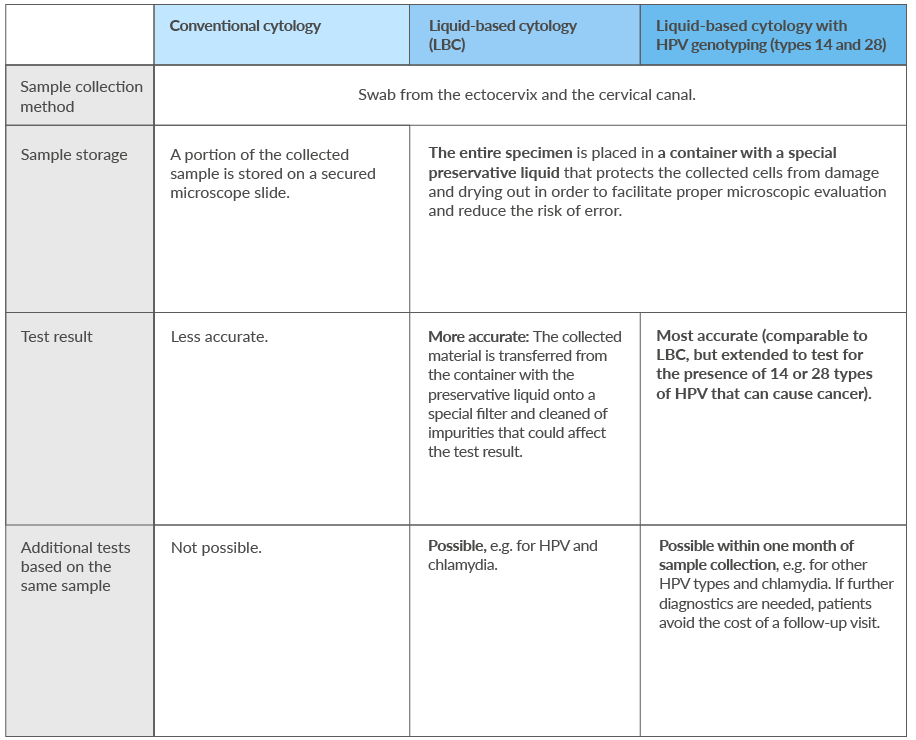
Why is it better to have liquid-based cytology with HPV-14 genotyping rather than conventional cervical cytology?
Click HERE to enlarge the table.

Advantages of liquid-based cytology (LBC) with HPV-14 genotyping over other types of cervical cytology
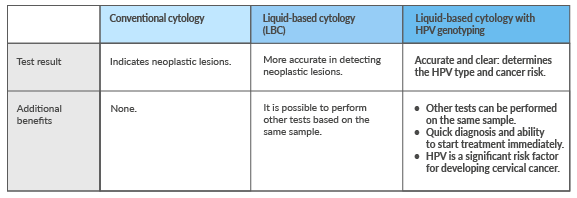
- Comprehensive assessment of epithelial cells along with 14 HPV types, providing a more accurate test result.
- High sensitivity of the test and the ability to analyse 100% of the material collected, allowing earlier treatment by increasing the detection rate for abnormal and neoplastic lesions.
- Accurate HPV genotyping and cancer risk assessment (there are over 40 types of genital HPV).
- The ability to perform additional tests based on the same sample (if needed), such as chlamydia, which can lead to infertility or ectopic pregnancy.
- Patients save money if the test result indicates the need for further diagnostics. As HPV is the most important risk factor for developing cervical cancer, it is crucial to detect the infection and determine the type of the virus.
3 types of cytology – comparison of benefits
To enlarge the table, click HERE.

For additional protection, consider getting vaccinated against HPV.
![]() |
The waiting time for the result is up to 14 days. If the test result is correct, you can pick it up in person at the Medical Center where the test was performed. If the test was performed at a Medicover Medical Center, you will be informed via SMS about the possibility of collecting the result. You can also check in Medicover Online if you have a Medicover subscription. If the result is abnormal, a medical worker will contact you by phone and offer you an inpatient consultation with a gynecologist at the Medical Center. If you do not have a subscription - the visit will be charged. If it is not possible to contact the patient, the results will be sent by Polish Mail with confirmation of receipt. Translated with DeepL.com (free version) |
Liquid-based cytology (LBC) is an alternative to conventional cytology. It is a modern and, above all, precise method of screening for cancer.
A brush with the collected material is in the first place transferred to a container filled with a proper fixative fluid, and then sent to a laboratory. Only in the laboratory, the suspension from the test tube is applied to the glass slide to obtain one layer of cells. In conventional cytology, the collected sample is transferred to the microscope slide while still in the doctor's office, right after collection. Liquid-based cytology allows for filtering out the impurities (e.g. blood, mucus, inflammatory cells) from preparation. Such impurities may hinder the assessment of cervical cells.
Placing the collected sample quickly in the fixative fluid prevents it from drying out. Additionally, it reduces the risk of errors in microscopic assessment due to inadequate fixation of the preparation. This makes it easier to find abnormalities.
Liquid-based cytology provides more cells for assessment than conventional cytology. This way it improves the quality of the smear assessment and reduces the number of false-negative results.
In countries where liquid-based cytology is already widely used, the percentage of incorrect samples and inconclusive results has decreased.
One of the factors that increase the risk of developing cervical cancer is chronic HPV ("human papillomavirus") infection. The genetic material of this virus has been observed in many neoplastic tumours of cervical cancer. So far, about 200 types of this virus have been discovered. Only some of them are high-oncogenic, i.e. particularly contributory to the development of cervical cancer. The others do not increase this risk (they are low-oncogenic), but they can cause the so-called viral warts. Extending the cytological test with HPV genotyping makes it possible to check whether the cells of the cervix are currently infected with HPV and with what type of the virus.
Contraindications for the examination:
Note that samples for the test cannot be collected during menstruation.
Test procedure:
- The sample collection for examination is performed on a gynaecological chair.
- It involves inserting a speculum into the vagina and collecting a sample of the exfoliated cervical epithelium. This procedure is virtually painless, although patients may feel mild discomfort.
- The entire test, including the preparation, takes just a couple of minutes.
How to prepare for sample collection:
- Sample collection for liquid-based cytology resembles a standard cytological test and requires a patient to be appropriately prepared. Instructions on how to prepare for the cytology are included in the documents tab.
Others also bought

Liquid-based cytology detects about 64% more high-risk lesions than conventional cytology and enables the early detection of human papillomavirus (HPV) infection – the virus that causes cervical cancer. Meanwhile, LBC with HPV-28 genotyping also makes it possible to determine the specific HPV type that can lead to cancer, making it easier to assess risk and increasing the chances of a complete cure.

HPV vaccination package (3-dose schedule) for children aged 15 years and older and adults. The vaccine prevents HPV infection. Infection with selected HPV types can lead to the development of cervical cancer, genital warts (condyloma) and cancer of the larynx.

Package includes 17 laboratory tests for all women who want to take care of their health. The package is dedicated for people over 16 years old.

New quality in cervical cancer diagnostics - liquid-based cytology, breast and gynaecological ultrasound, as well as a consultation with a midwife and an appointment with a gynaecologist. All in one package!